




🇧🇮 Burundi: A Journey Through East Africa’s Heartland
Located in East Africa, Burundi is a small country with a rich cultural heritage, stunning highlands, and a strong agricultural economy. Burundi is one of the most ethnically cohesive and densely populated nations in sub-Saharan Africa, despite its small size. Burundi, a landlocked nation surrounded by Rwanda, Tanzania, the Democratic Republic of the Congo, and Lake Tanganyika, is a cultural haven, a trekker’s dream, and a representation of tenacity.
🏺 History of Burundi
🌄 Ancient Kingdoms and Ethnic Unity
The Kingdom of Burundi, which was founded in the 1600s, is where Burundi got its start. Since colonisation, its borders have mainly not changed. The Hutu, Tutsi, and Twa ethnic groups—all of whom speak Kirundi—were brought together under the monarchy. Rare in Africa, this linguistic homogeneity influences the nation’s current cultural cohesion. (Encyclopedia Britannica, cia.gov).
🧭 Colonial Rule and Independence
Burundi maintained its royal institutions during German (1894–1916) and then Belgian rule over Ruanda-Urundi, but colonial administration institutionalised power disparities. After gaining independence in 1962, Burundi became the Republic of Burundi, which was subsequently renamed République du Burundi in French and Republika y’Uburundi in Kirundi.(IMUNA | NHSMUN | Model UN).(Wikipedia)
⚖️ Ethnic Conflict and Political Transformation
Hutu and Tutsi communities engaged in violent cycles after independence, culminating in a catastrophic civil war that started in the 1990s. The tragic themes of democratic upheaval, ethnic tension, and reconciliation continue to be at the heart of Burundi’s current narrative. (Encyclopedia Britannica).
🗺️ Geography & Location
📍 Where is Burundi?
Burundi is located in East Africa and is bounded to the north by Rwanda, to the east and south by Tanzania, to the west by the Democratic Republic of the Congo, and to the southwest by Lake Tanganyika.(Wikipedia).
- Coordinates: ~3° S, 30° E (central region)
- Area: ~27,834 km²
- Highest Point: Mount Heha ~2,684 m
- Lowest Point: Lake Tanganyika ~772 m (Wikipedia)
🌳 Terrain & Natural Features
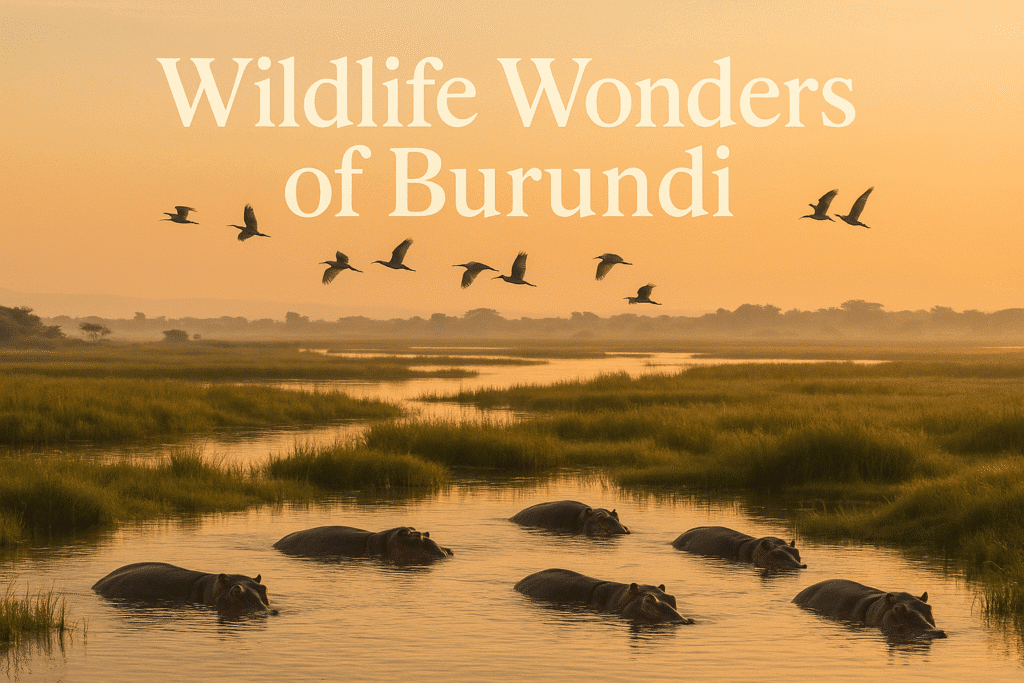
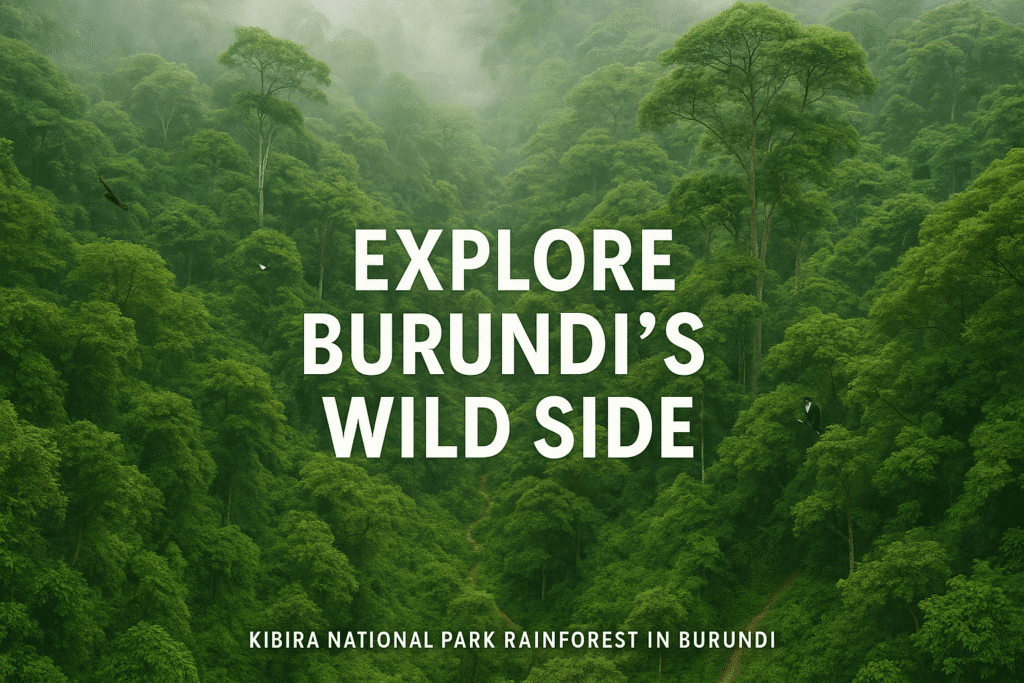
The terrain of Burundi includes savanna central plains, the eastern escarpment of the Great Rift Valley, and rolling plateaus. Although deforestation is still a major problem, lush forests cover about 11% of the land, and major rivers include the Ruvyironza and Rusizi.(Wikipedia).
🎭 Culture, Traditions & Cuisine
🗣️ Languages and Ethnic Identity
English, French, and Kirundi (spoken by approximately 98%) are Burundi’s official languages, though the latter two are not widely used. Trade regions close to Lake Tanganyika and Bujumbura are home to Swahili speakers (Encyclopaedia Britannica). Through Kirundi, the Hutu and Tutsi communities are able to share cultural and linguistic ties. (Encyclopedia Britannica).
🙏 Religion and Worldview
Burundi has a wide range of religious customs:
- About 60 percent are Roman Catholic, and 13 to 20 percent are Protestant.
- Islam and other traditional religions are practiced by less than 5% of people.
- Despite political unrest, this religious diversity strengthens Burundi’s social cohesiveness.(Encyclopedia Britannica).
🎶 Festivals and Artistic Heritage
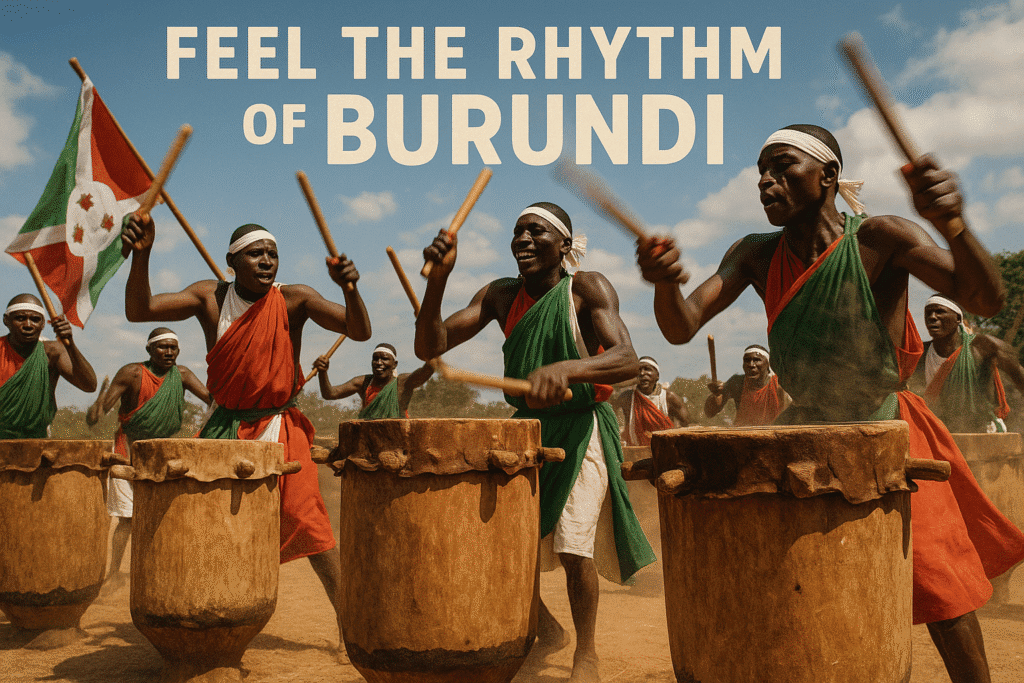
Music, masked rituals, and royal drum ceremonies all contribute to Burundi’s cultural identity. The chants of the Abatimbo drummers, who were once listed as UNESCO Intangible Cultural Heritage, are essential to the country’s identity. Burundian creativity is also displayed at art venues such as FESPACO (Ouagadougou’s film festival). (Wikipedia).
🍲 Cuisine: A Taste of Burundi
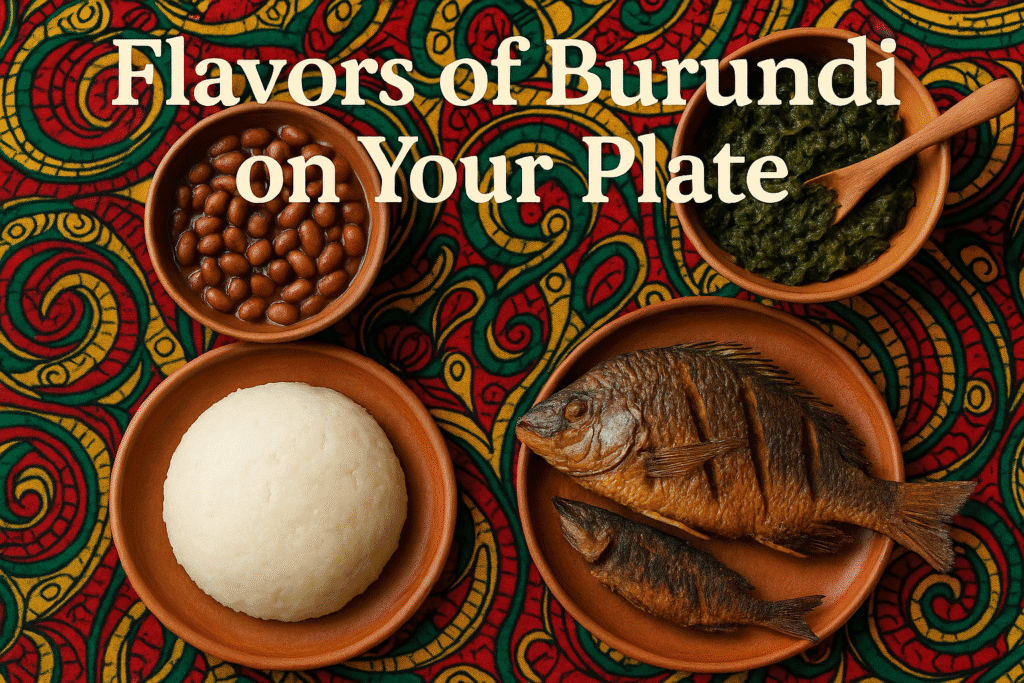
Traditional Burundian dishes reflect local ingredients and farming traditions:
- Tô (millet, sorghum, or maize paste) served with peanuts or leafy greens
- Riz gras (rice cooked with vegetables and meat)
- Poulet bicyclette (grilled chicken with mustard and onions)
- Millet is used to make local dolo beer.
- The subsistence and communal values of Burundi life are emphasised by this cuisine. (IMUNA | NHSMUN | Model UN, World Bank).
Culture and Traditions of Burundi
The rich mosaic of Burundi’s culture is firmly anchored in customs and communal values. Despite the changes brought about by modernisation, Burundian identity is still deeply rooted in traditional customs.
Traditional Clothing and Dance
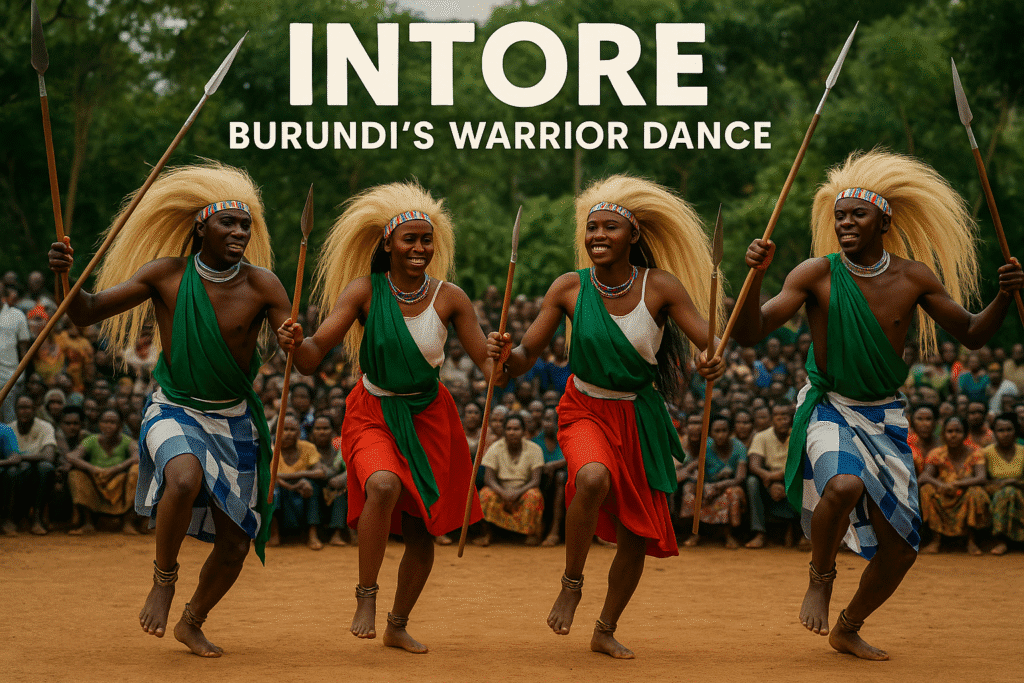
During festivals and ceremonies, Burundians continue to dress traditionally. Common cloths are “igitenge” and “imvutano,” which are wrap dresses for women. Men may dress in Western attire or long tunics.
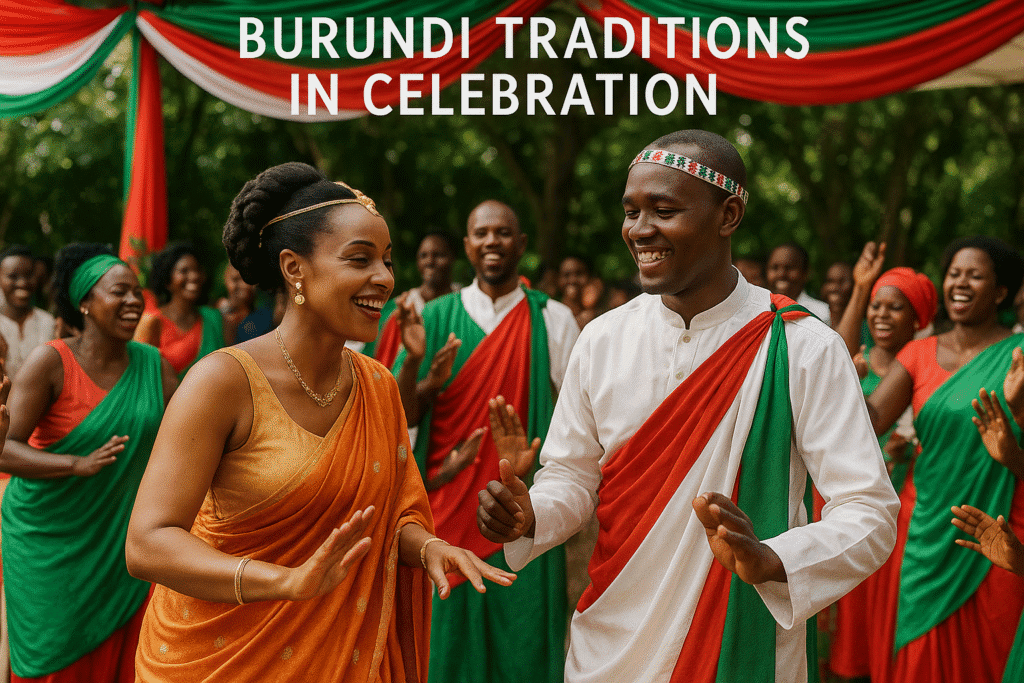
Burundi’s traditional dance is a remarkable sight and sound spectacle. Large wooden drums known as “karyenda,” which stand for divine authority, are used by the well-known Royal Drummers of Burundi. These musical performances are used in spiritual and royal ceremonies and are regarded as sacred, so they are not merely for amusement.
Religion
The majority of people in Burundi are Christians, with Catholics making up the largest group (roughly 62%) and Protestants coming in second (roughly 23%). Indigenous animism and traditional beliefs are still prevalent, particularly in rural areas. A tiny portion of the populace, mostly in cities like Bujumbura, also practise Islam.
National Festivals and Public Holidays
- July 1st is Independence Day, a celebration of Burundi’s 1962 separation from Belgium.
- Unity Day, observed on February 5th, encourages national unity and reconciliation.
- The Drumming Festival honours the drum’s significance in Burundian culture.
- The Umuganura Festival is a Thanksgiving celebration that ushers in the harvest season.
Parades, customary performances, communal meals, and athletic events are all part of these celebrations.
Food and Cuisine
Due to limited access to meat, Burundian cuisine is straightforward, filling, and mostly vegetarian. Typical staples consist of:
- A stiff porridge made with cassava or maize flour is called ugali.
- Isombe is a stew made with cassava leaves, peanuts, and spices.
- Bananas and beans are frequently served together as a basic meal.
- Brochettes are skewers of meat or fish that are cooked over open flames.
- Ibiharage is a dish made with spicy beans.
Urwarwa, a homemade banana wine that is typically brewed during festivals, is a must-try local beverage.
Economy of Burundi
Overview
More than 85% of people in Burundi rely on subsistence farming, making agriculture a major part of the country’s economy. Because of political unrest, a lack of infrastructure, and overcrowding, the nation is among the poorest in the world despite having rich soil and copious amounts of rainfall.
Major Industries
- Agriculture (coffee, tea, maize, bananas)
- Mining (nickel, gold, and rare earth elements)
- Manufacturing (mostly for local consumption)
- Services (tourism and trade)
The primary export goods, which account for over 90% of foreign exchange profits, are coffee and tea. Because Burundi has one of the world’s largest untapped nickel reserves, the government is also concentrating on nickel extraction.
Currency
The Burundian Franc (BIF) is the country’s currency. Over the years, the BIF has experienced severe devaluation as a result of inflation and low foreign reserves.
Trade Partners
Among Burundi’s principal trading partners are:
- Democratic Republic of the Congo
- Tanzania
- Rwanda
- China
- Belgium
Due to its landlocked status and dependence on the ports of its neighbours, Burundi continues to face trade difficulties.
Languages Spoken in Burundi
The following are Burundi’s official languages:
- Nearly all Burundians speak Kirundi.
- French (used in education and government)
- English was adopted in 2014 to conform to the standards of the East African Community.
In border towns and marketplaces, Swahili is also widely spoken, particularly for trade.
Major Cities in Burundi
Bujumbura

Bujumbura continues to be the country’s cultural and economic centre, despite Gitega serving as the political capital. Situated on the northeastern shore of Lake Tanganyika, it provides access to beach resorts, nightlife, and lakeside attractions.
Gitega
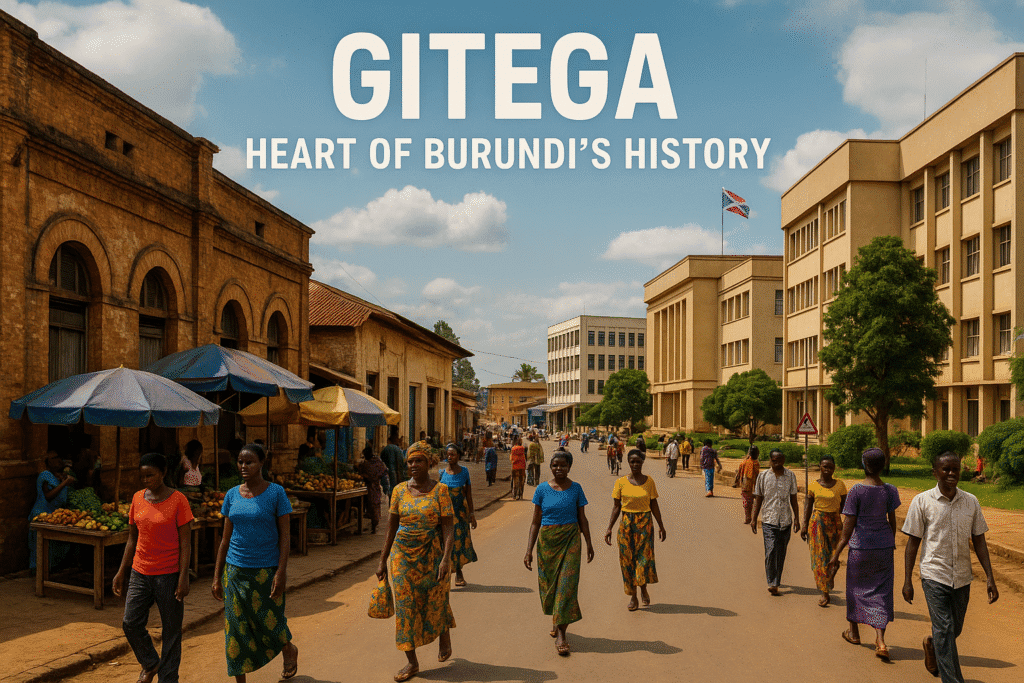
The National Museum of Burundi, royal drum sanctuaries, and traditional monarchy history can all be found in Gitega, which was designated the country’s capital in 2019.
Ngozi
renowned for its educational institutions and coffee farming, this city is the third largest.
Major Cities in Burundi
1. Bujumbura
The largest city in Burundi and the former capital, Bujumbura, is located next to Lake Tanganyika. It serves as the nation’s principal port and commercial centre. Bujumbura, Burundi’s cultural and economic hub, was once the country’s political centre.
Highlights include:
- Livingstone-Stanley Monument
- Musee Vivant (Living Museum)
- Lake Tanganyika beaches
2. Gitega
Burundi’s current political capital, Gitega, is situated in the country’s centre. In 2019, it was designated as the capital for decentralised governance. The city is also well-known for its museums and traditional drum sanctuaries.
Don’t miss:
- Gitega National Museum
- Royal Drum Sanctuary
3. Ngozi
Situated in Burundi’s northern region, Ngozi is one of the towns with the fastest rate of growth. It serves as a centre for both cross-border trade and agriculture with Rwanda.
Key features:
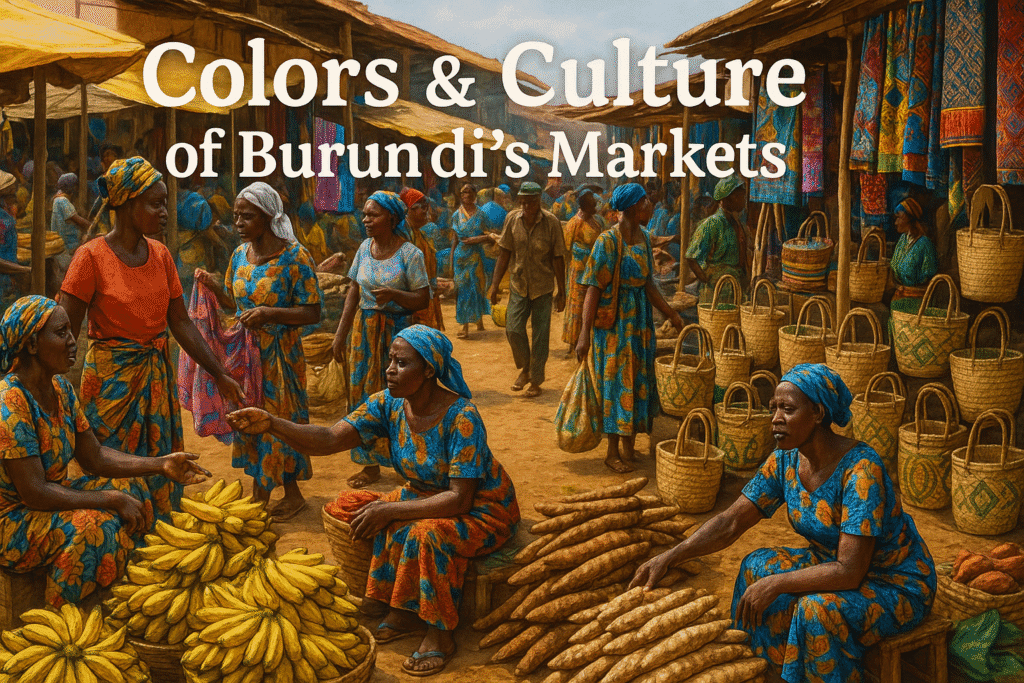
- Local markets
- Coffee cooperatives
- Rural lifestyle experiences
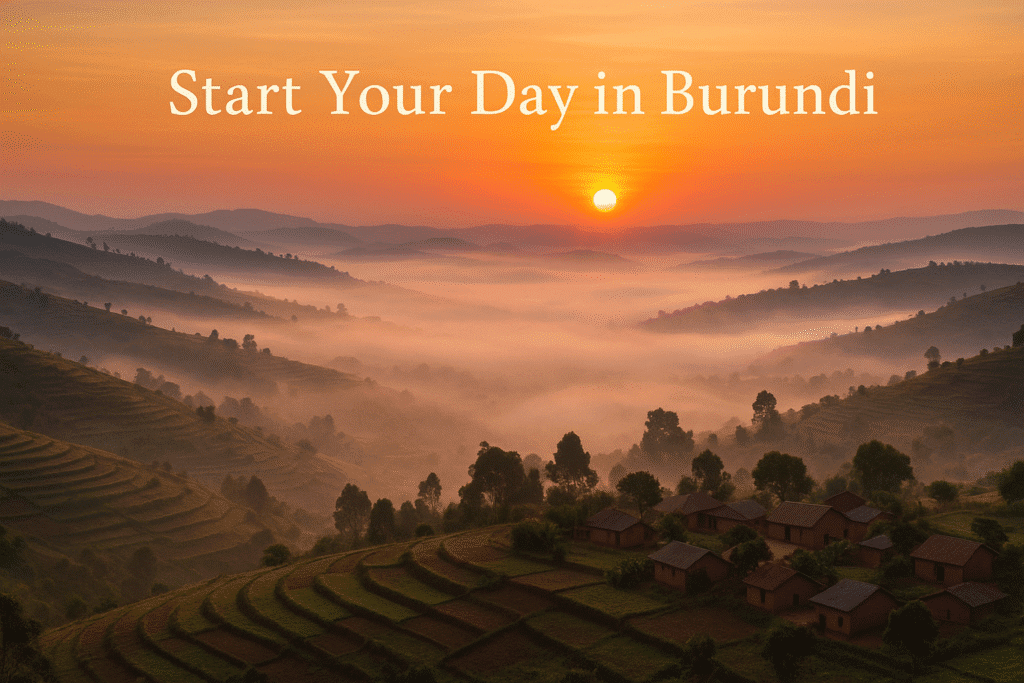
Best Time to Visit Burundi
There are two dry and two wet seasons in Burundi’s temperate equatorial climate:
- The best months to go are June through August (dry season, when the skies are clearer and cooler).
- December to January (a brief dry period) is a secondary good time.
- Steer clear of: March through May (long rainy season) because of muddy roads and rural flooding.
Top tips:
- Bring clothes that are breathable and light.
- If you are travelling during the rainy seasons, remember to bring rain gear.
- Because malaria mosquitoes are present, insect repellent is necessary.
How to Travel Around Burundi
Air Travel:
The primary international entry point is Bujumbura International Airport (BJM). From Nairobi, Addis Ababa, and Kigali, regional flights are available.
Road Travel:
The majority of travel in Burundi is done by road. In cities, motorcycles (boda-bodas), shared taxis, and minibuses are all common. Although most roads are paved, rural areas may have uneven surfaces.
Car Rental:
For safaris and rural excursions, tourists can rent 4×4 vehicles; however, because of the difficulties in the terrain, local drivers are advised.
Unique and Interesting Facts About Burundi
- Dating back to the 16th century, Burundi is among Africa’s oldest kingdoms.
- The second-deepest lake in the world, Lake Tanganyika, is a significant fishery for Burundians.
- The Burundi Drummers’ participation in cultural ceremonies has earned them recognition from UNESCO.
- All ethnic groups speak Kirundi, which represents national cohesion.
- Burundi coffee is regarded as one of the world’s finest speciality coffees.
Membership in Global Organizations
Burundi is a member of the following international bodies:
- United Nations (UN)
- African Union (AU)
- East African Community (EAC)
- World Health Organization (WHO)
- International Monetary Fund (IMF)
- World Trade Organization (WTO)
Additionally, Burundi collaborates with regional projects that support development, economic integration, and peace.
Final Summary
Despite its small size and lack of international recognition, Burundi is a nation rich in cultural traditions, heritage, and scenic beauty. From the hills of Gitega to the shores of Lake Tanganyika, the country is a mesmerising fusion of vibrant drumming, resilient people, and royal legacies. Burundi maintains its identity through dance, music, and communal values despite its economic difficulties. Burundi provides a heartfelt journey through East Africa’s hidden gem for tourists looking for authenticity and off-the-beaten-path experiences.
Key Facts Table
| Attribute | Details |
| Continent | Africa |
| Capital City | Gitega |
| Largest City | Bujumbura |
| Official Languages | Kirundi, French, English |
| Currency | Burundian Franc (BIF) |
| Population | ~13 million (2024 estimate) |
| Main Exports | Coffee, Tea, Gold |
| Religion | Christianity (mainly Roman Catholic) |
| Time Zone | Central Africa Time (UTC+2) |
| Calling Code | +257 |
- United Nations – Burundi Profile
https://www.un.org/en/member-states/burundi
(Verifies Burundi’s participation in international diplomacy and UN membership.) - World Bank – Burundi Overview
https://www.worldbank.org/en/country/burundi
(Details about Burundi’s statistics, development initiatives, and economy.) - UNESCO – Burundi’s Intangible Cultural Heritage
https://ich.unesco.org/en/state/burundi-BI
(Dance and drumming are examples of cultural traditions that were preserved.) - African Development Bank – Burundi Projects
https://www.afdb.org/en/countries/east-africa/burundi
(Includes projects related to health, education, and infrastructure.) - CIA World Factbook – Burundi
https://www.cia.gov/the-world-factbook/countries/burundi/
(Extensive socioeconomic and geopolitical data.) - Burundi National Tourism Office
https://www.burunditourisme.gov.bi (French)
(Requirements for visas, tourist destinations, and official travel information.) - BBC Country Profile – Burundi
https://www.bbc.com/news/world-africa-13085064
(A summary of current events, politics, and history.)
International Monetary Fund (IMF) – Burundi Reports
https://www.imf.org/en/Countries/BDI
(Policy recommendations, growth projections, and macroeconomic analyses.)



[…] 28.Burundi: Culture, History & Travel Guide […]
[…] 28.Burundi: Culture, History & Travel Guide […]
[…] 28.Burundi: Culture, History & Travel Guide […]
[…] 28.Burundi: Culture, History & Travel Guide […]